Some of these were done by hand ( hammer, chisel and handsaw) and others were made with machines. Part of my Furniture Making Qualifications covered the Settings and safe use of machinery.


UNIT STANDARDS.

CAR101 Health and Safety

6400 Manage First Aid
6401 Provide First Aid
6402 Provide basic life support
12997 Demonstrate knowledge of safe working practices on construction site.


CAR102 Carpentry Theory #1


12998 Demonstrate knowledge of carpentry hand tools
12999 Demonstrate knowledge of timber machining equipment used on construction sites
13000 Demonstrate knowledge of portable power tools used on construction sites
24378 Perform building calculations

CAR103 Carpentry Theory #2


13002 Demonstrate knowledge of timber used in construction
13004 Demonstrate knowledge of setting out a building
13032 Demonstrate knowledge of non-mechanical and mechanical construction equipment
13033 Demonstrate knowledge of alternative building construction methods
24362 Demonstrate knowledge of working drawings and specifications for building work
24379 Demonstrate knowledge of preliminary work needed for construction
24392 Demonstrate knowledge of alterations and additions for construction

CAR104 Carpentry Theory #3


12933 Complete minor concrete works as a BCATS project
13005 Demonstrate knowledge of spot levels and contour plans
13010 Demonstrate knowledge of making and placing concrete
13015 Demonstrate knowledge of construction subcontractors' work and main contractor's responsibilities
13028 Demonstrate knowledge of adhesives and sealants used in construction work
13029 Demonstrate knowledge of erecting in situ high wall, column, beam, and slab falsework and formwork

CAR105 Carpentry Theory #4


13006 Demonstrate knowledge of preparation for footings and slab on ground construction
13008 Demonstrate knowledge of formwork for footings, foundations, beams and walls up to 1.2 metres
13009 Demonstrate knowledge of fabrication and placing of reinforcing steel and steel mesh
13011 Demonstrate knowledge of construction of sub floor framing and flooring

CAR106 Carpentry Theory #5


13012 Demonstrate knowledge of setting out and erecting wall frames
13013 Demonstrate knowledge of equal pitch gable and hip roof construction
13014 Demonstrate knowledge of alternative roof structures
13031 Demonstrate knowledge of regulations and precautions for demolition work
24380 Demonstrate knowledge of construction of pile foundations
24381 Demonstrate knowledge of floor framing and flooring construction

CAR107 Carpentry Theory #6


13016 Demonstrate knowledge of timber and metal scaffolds up to five metres
13019 Demonstrate knowledge of the installation of metal and translucent roof claddings and roof lights
13023 Demonstrate knowledge of selection and installation of mechanical fixings and building hardware
13024 Demonstrate knowledge of features and construction of pole frames and pole platforms
13026 Demonstrate knowledge of retaining wall construction
24385 Demonstrate knowledge of construction principles and installation of exterior and interior joinery, showers and baths
24386 Demonstrate knowledge of thermal insulation and sound control for buildings
24388 Demonstrate knowledge of cutting, fitting and fixing interior linings and trim
24389 Demonstrate knowledge of stair and ramp construction
24391 Demonstrate knowledge of the construction of concrete masonry structures and paving

CAR108 Carpentry Practical


7502 Produce an instrumental orthographic drawing
13020 Demonstrate knowledge of alternative roof cladding materials and their installation requirements
13034 Demonstrate knowledge of prefabricated beams used in construction
21211 Demonstrate knowledge of the principles of, and methods used in weatherproofing buildings
24363 Demonstrate knowledge of proprietary suspended concrete floor systems
24364 Demonstrate knowledge of compliance with building legislation

ADS101 Fall Arrest Systems

15757 Employ fall arrest systems on building and construction sites
MODULE 1:

FIRST AID/HEALTH AND SAFETY.


http://www.osh.govt.nz/publications/factsheets/first-aid-at-work.html

http://www.stjohn.org.nz/

http://www.consumerbuild.org.nz/publish/DIY-safety-tools.php


The first aspect of my pre trade Carpentry course we covered was Health and Safety/First aid. I completed and passed a two day First Aid course run by City First Aid.
The course covered many areas of on-site related accidents and scenarios that I may encounter during my career, we were taught how to manage those situations.
Heath and safety covered general safety on the building site along with the safe use of powertools. I passed the necessary units for safety along with obtaining a paslode nail/framing gun license and site safe certificate.

http://en.wikipedia.org/wiki/Personal_protective_equipment

http://www.osh.govt.nz/index.asp

.
*Priority number one to me is Having and using the appropiate Personal Protective Equipment (PPE).
MODULE 2:

SITE PREPERATION

This module covers the processes for pre foundation construction,
which covers areas like ...Resource consents, PIM, Code of Compliance Documents, Building consents e.t.c. these can be obtained from your local Councils.
Along with that I have learnt the Mathematical equations needed for planning the build regarding site area, volume of goods to order and how to work out lengths for rafters and pitch of roof by using a few common formulas.

Stages in a building project

Once the plans are drawn, the materials have been chosen, and your finance is arranged, the next steps in the building process are likely to be:

  1. Finding a builder (and subcontractors if you are managing the building project yourself).
  2. Getting tenders and quotes.
  3. Revising the budget, if necessary.
  4. Making your selection of builder and subcontractors.
  5. Signing the contracts.
  6. Making sure the appropriate insurance has been organised.
  7. Applying for building and resource consents if not already underway - the applications may already have been lodged by you or your architect or designer.
  8. Construction starts:
    -
    Monitoring progress
    - Making progress payments
    - Approving variations to structure or materials
    -
    Building inspections by the Building Consent Authority (BCA)inspectors.
  9. Final stages:
    - completion and final inspections for the code compliance certificate
    - retentions and remedial work
    - final payment.
  10. Dealing with problems when things go wrong.
  11. Landscaping.

Often these steps happen together, or in a different order, depending on your circumstances.

Your responsibilities - checklist

It is recommended that you have active involvement during construction.

Before work begins:

  • Make sure building consent has been issued.
  • Make sure that you understand all the documentation – have the architect or builder explain the plans and specifications to you and make sure you are happy with the design – changes during construction are likely to be costly.
  • From March 2012, if the work is restricted building work, make sure the appropriate licensed building practitioners will be designing and carrying out or supervising out the work.
  • Talk to a lawyer about the contract.
  • Ensure that the site is cleared and ready for the builder to start work.
  • Make sure your builder has unhindered access to the site.
While work is in progress:

  • Develop a good working relationship with your builder. If you have any concerns about the work, discuss them right away.
  • Keep changes to a minimum and instruct your builder in writing about all variations to the specified work and ensure you get a written costing. Be aware any changes you make may mean you have to amend your building consent.
  • Choose materials and finishes carefully and approve them before use.
  • If you are responsible for choosing the appliances and any other materials or fittings and fixtures, make sure they are already bought when the builder reaches that stage.
  • Keep to the payments schedule and pay promptly.
When the work is complete:

  • Report any urgent defects to your builder promptly and in writing.
  • List any non-urgent defects for your builder to correct at an agreed time.
  • Settle the final account promptly.
  • It is your responsibility to apply for a code compliance certificate when the building work is complete.

 mathematical theory's used by builders/carpenters


THE PYTHAGORAN THEORY:
Usually, this theorem is expressed as A2+B2=C2


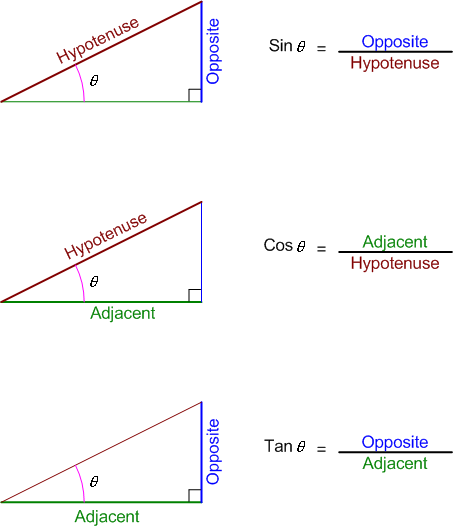
Soh Cah Toa
A meaningless mnemonic that helps you remember the definitions of the sine, cosine, and tangent functions. SohCahToa uses the initial letters of sine, cosine, and tangent, and the initial letters of hypotenuse, opposite, and adjacent, to help you remember the following definitions.


Area of a square = Length x width
Area of a triangle = Half (Base x Height)

Area of a circle = 3.142 x radius squared

VOLUME

MODULE 3

*SUBSTRUCTURE.       


Getting on site.


*Hazard boards record new, ongoing and unusual significant hazards specific to a site - along with their required control:
  • Hazard boards should be installed at site main entrance
  • The site main contractor keeps the hazard board up to date, including hazards created by subcontractors if they affect others on-site
  • Hazard board also describes the hazard’s required control measures
  • Hazard boards must be kept up-to-date
  • The hazard board safety system requires effective communication, monitoring and feedback.
*Tools and Materials.

At this stage I will require a few tools and they will be a Hammer + maul or sledge (for putting in stakes), Nails, Stringlines, Dumpy and Laser level, Steel bar, tape measures (variety of sizes) straight edge and spirit level, dazzle or high vis paint.


* FOUNDATIONS

When setting up the Laser Level the ground needs to be solid and will not move. As well as stability, there needs to be clear vision across the whole site from where the level is set up.


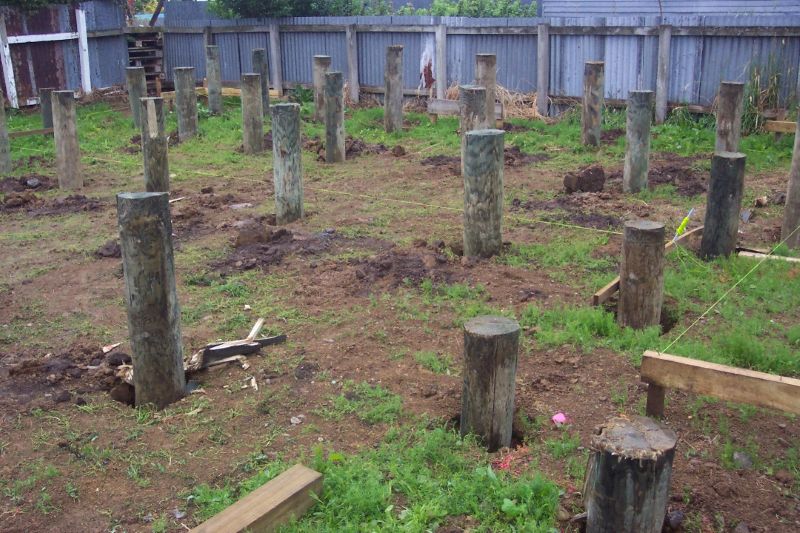
After we set up the profiles, we then marked out the Pile locations, centre pads and the corner pads for the house.(All which was read from the house plans and specs) This building is a transportable home, and therefore we are placing it on foundations which will allow trucks to come in and just pick the house up off the piles and then to the new location.
Once we were satisfied that they were set up square and straight we then pored concrete in the holes.
MODULE 4:                    *STRUCTURE

        This module covers flooring, framing and roofing  aswell as the bracing requirements that go with them. For more information on the specs of how the floors and walls are fixed refer to these sites... 
http://www.branz.co.nz/cms_display.php,
 http://www.mii.com/artefact/download.asp?aid=65574

   *FLOORING

When the concerete had set we now need to put on the Boundry joists, bearers and floor joists. To do this we read the plans and specifications, this will give us the length and sizes along with location of where to put the bearers and joists.
      It is important to make sure that the joists are in the right places to allow the floor sheets to be fixed onto, to do this we use either the in and over or the centre to centre measuring methods.


At this stage it is extremely important to ensure that this section of flooring is square and straight otherwise the house will be constructed incorrectly and cause a number of problems. to do this once the floors are squared and straightened we put a brace across the corners to keep it in place.


                   General Knowledge segment.

 Here are a few commonly used nails in the building trade along with a light description about the nail and how it is used. Using the wrong nail for the job can cause damage to the wood and lack holding power.


Common nails are the most widely used nail used in general construction and are the nail type used where building code requires certain framing construction. These nails have a thick shank and are made from iron wire. They are most commonly used with dimensional lumber (e.g., 2x4 framing). The common nail has a wide head having a smooth or textured surface and has a sharp diamond shaped point.


Box nails are wire nails similar to common nails except that they have thinner shanks and are not to be used for dimensional lumber framing construction requiring common nails. This is because box nails do not have as thick a shank as a common nail and have less holding power.


Duplex head nails are a specialty nail useful for temporary construction, such as form work when pouring concrete. Let's say you were setting up a form for pouring a section of sidewalk. You'd use this type of nail to put the forms together.
The nail's double head (duplex) makes it easier to remove and pull out of the form boards or other temporary construction.

Annular ring or ring shank nails are another specialty wire nail that have rings on the shank providing better grip and additional resistance to pull-out of the lumber. This type of nail is also used for drywall nails or deck board nails because of the pullout resistant feature of the annular rings on the nail shank.

Casing and finishing nails are similar and differ primarily in the shape of the heads. A finishing nail has a small slightly rounded head just a tad bit bigger than the nail shank. The head is designed to fit into a nail set to be countersunk and the nail hole filled.
A casing nail is often used in exterior applications and is often galvanised. The nail head of a casing nail is tapered and may be set flush or just below the wood surface.


TIMBER GRADES AND USES.

Once timber has been cut at a mill it the gets graded.  These grades are rated by strength and visual appearance. for example..

Clears grade
This timber has no knots or deffects in it and is used for making furniture.
Timber Grade: No1 Clears - pine


Dressing Grade
A tight knot grade for use in furniture, panelling, and high quality exterior use. Contains a few defects but can be used effectively in furniture.
Timber Grades: dressing grade -  Pine


Packing/Boxing Grade
Suitable for packaging, pallets and other industrial use. This Grade contains many defects and is therefore used for non-visual purposes like the boxing for cement work.
Timber Grade: Packaging  Industrial grade - Pine

TREATED TIMBER.

H1 = Low decay hazard. This includes timber used for framing, interior lining and trim.


H3 = Moderate decay hazard. Timber is exposed to weather but not in ground contact. eg. Fence rails.


H4 = A high decay hazard. Timber is exposed to the ground and fresh water. For example: sawn timber, fence posts, retaining walls, horticultural poles.


H5 = Severe decay hazard, eg. building piles and poles


H6 = A marine hazard or water immersion, eg. marine piles