
SITE PREPERATION
This module covers the processes for pre foundation construction,
which covers areas like ...Resource consents, PIM, Code of Compliance Documents, Building consents e.t.c. these can be obtained from your local Councils.
Along with that I have learnt the Mathematical equations needed for planning the build regarding site area, volume of goods to order and how to work out lengths for rafters and pitch of roof by using a few common formulas.
Stages in a building project
Once the plans are drawn, the materials have been chosen, and your finance is arranged, the next steps in the building process are likely to be:- Finding a builder (and subcontractors if you are managing the building project yourself).
- Getting tenders and quotes.
- Revising the budget, if necessary.
- Making your selection of builder and subcontractors.
- Signing the contracts.
- Making sure the appropriate insurance has been organised.
- Applying for building and resource consents if not already underway - the applications may already have been lodged by you or your architect or designer.
- Construction starts:
- Monitoring progress
- Making progress payments
- Approving variations to structure or materials
- Building inspections by the Building Consent Authority (BCA)inspectors. - Final stages:
- completion and final inspections for the code compliance certificate
- retentions and remedial work
- final payment. - Dealing with problems when things go wrong.
- Landscaping.
Often these steps happen together, or in a different order, depending on your circumstances.
Your responsibilities - checklist
It is recommended that you have active involvement during construction.
Before work begins:
- Make sure building consent has been issued.
- Make sure that you understand all the documentation – have the architect or builder explain the plans and specifications to you and make sure you are happy with the design – changes during construction are likely to be costly.
- From March 2012, if the work is restricted building work, make sure the appropriate licensed building practitioners will be designing and carrying out or supervising out the work.
- Talk to a lawyer about the contract.
- Ensure that the site is cleared and ready for the builder to start work.
- Make sure your builder has unhindered access to the site.
- Develop a good working relationship with your builder. If you have any concerns about the work, discuss them right away.
- Keep changes to a minimum and instruct your builder in writing about all variations to the specified work and ensure you get a written costing. Be aware any changes you make may mean you have to amend your building consent.
- Choose materials and finishes carefully and approve them before use.
- If you are responsible for choosing the appliances and any other materials or fittings and fixtures, make sure they are already bought when the builder reaches that stage.
- Keep to the payments schedule and pay promptly.
- Report any urgent defects to your builder promptly and in writing.
- List any non-urgent defects for your builder to correct at an agreed time.
- Settle the final account promptly.
- It is your responsibility to apply for a code compliance certificate when the building work is complete.
mathematical theory's used by builders/carpenters
THE PYTHAGORAN THEORY:
Usually, this theorem is expressed as A2+B2=C2
Usually, this theorem is expressed as A2+B2=C2
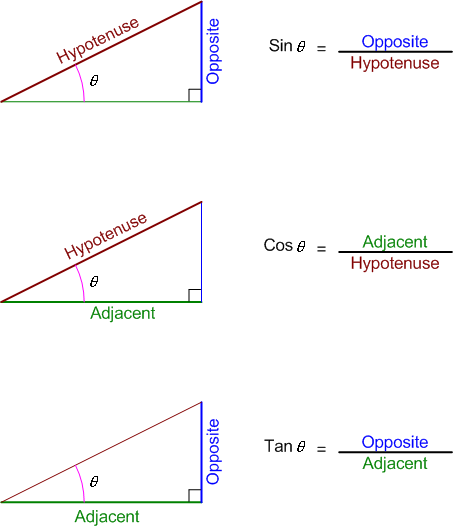
Soh Cah Toa
A meaningless mnemonic that helps you remember the definitions of the sine, cosine, and tangent functions. SohCahToa uses the initial letters of sine, cosine, and tangent, and the initial letters of hypotenuse, opposite, and adjacent, to help you remember the following definitions.
Area of a square = Length x width


Area of a circle = 3.142 x radius squared

VOLUME


No comments:
Post a Comment